Research
Core Research Topics
Graph Representation Learning
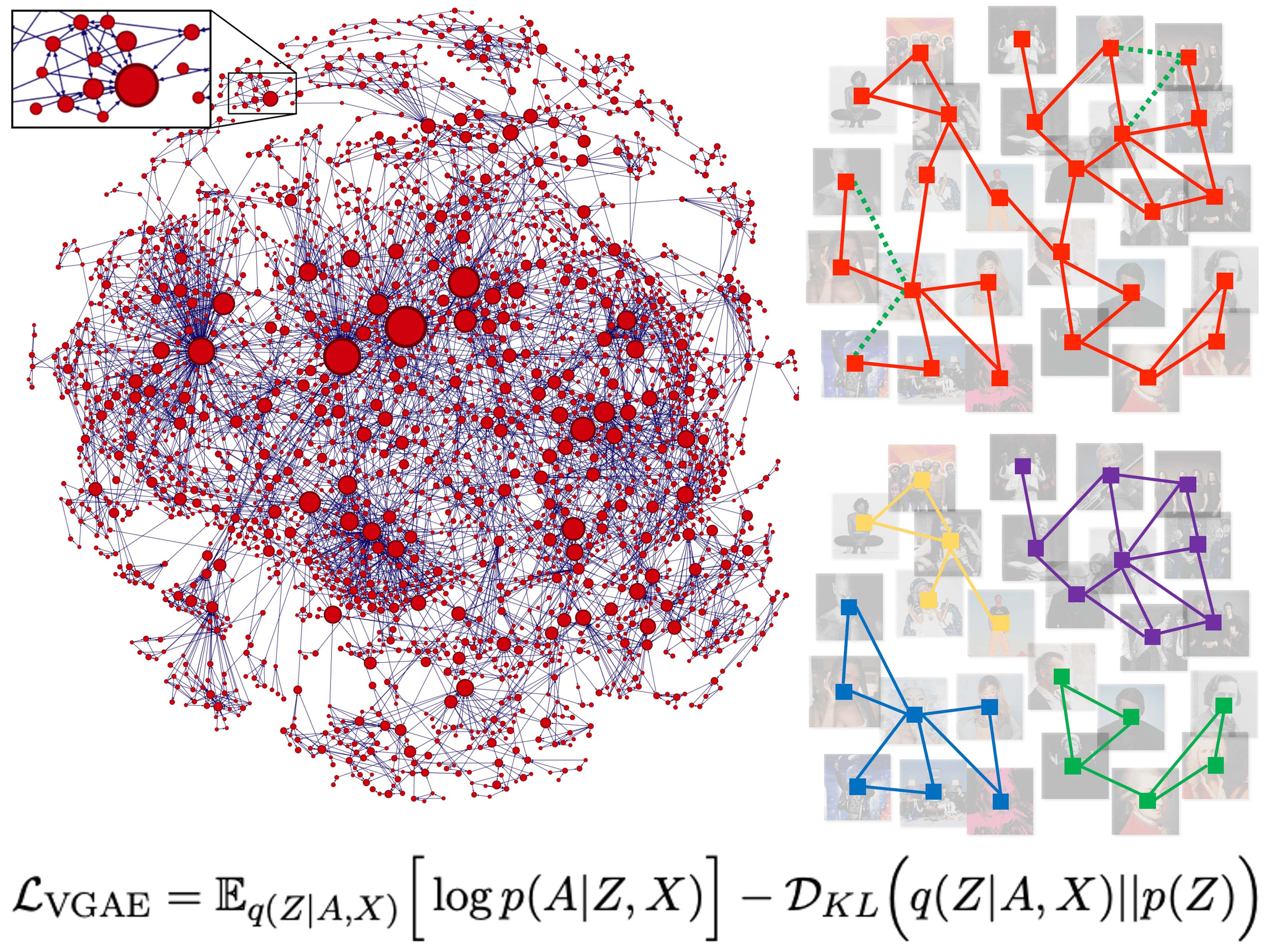
My research journey began with the study of graphs during my doctoral studies at École Polytechnique. These structures are ubiquitous in domains such as web mining, social networks, and biology, where data often represent entities (or nodes) connected by links (or edges) capturing their relationships or interactions.
Extracting meaningful information from graphs is essential for solving a wide range of machine learning problems, including link prediction [1], community detection [2], and influence maximization [3]. My research in this context focuses on graph representation learning, which aims to automatically learn low-dimensional vector representations, also known as "embeddings," of nodes, edges, or entire (sub)graphs that capture and summarize key graph properties [4]. I am equally interested in the theoretical foundations of these representations and in how they can enable empirical advances across downstream tasks.
In particular, a significant portion of my research has focused on graph autoencoders (GAEs) and variational graph autoencoders (VGAEs), two powerful families of unsupervised graph neural networks for learning node embeddings [4]. While early GAEs and VGAEs showed promise, they faced limitations in scalability and structural flexibility, restricting their adoption in real-world scenarios. My research addresses these challenges by introducing architectural enhancements that extend their practical applicability: enabling scalability to graphs with millions of nodes [5, 6], adapting them to diverse topologies including dynamic and directed graphs [1, 4, 7], simplifying their architectures [8, 9, 10], and improving robustness across multiple graph learning tasks [2, 11]. These contributions help bridge the gap between the theoretical design of GAEs and VGAEs and their deployment in large-scale, real-world applications.
Recommender Systems
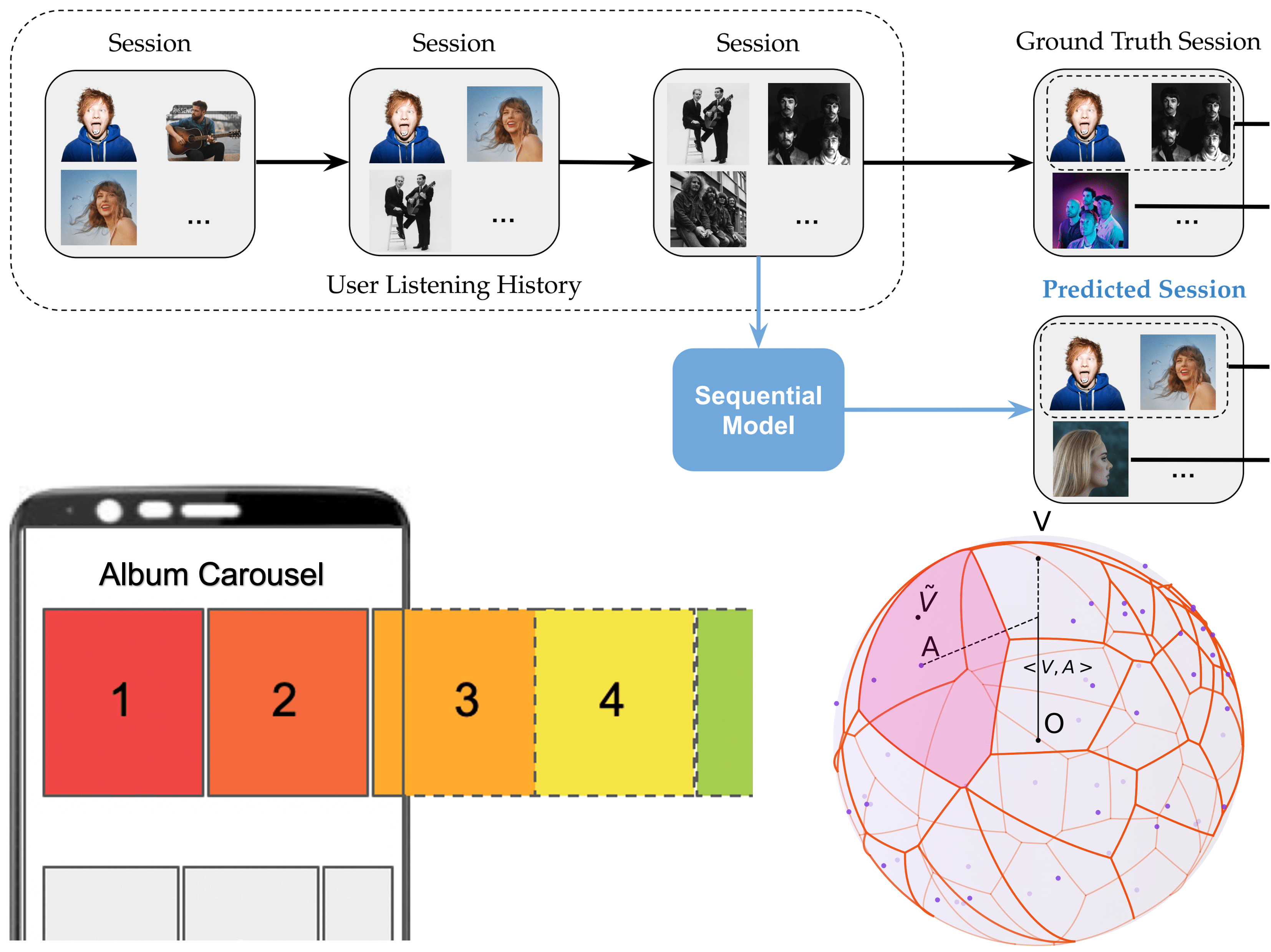
Another strong research interest of mine, particularly since my time at Deezer, centers on recommender systems. Online platforms such as music and video streaming services rely on recommendation algorithms to personalize user experiences. They play a crucial role in helping users navigate large catalogs and discover new content aligned with their preferences. Recommender systems are widely recognized as key drivers of user satisfaction and engagement [12].
I have explored various foundational research questions in this field, with a particular focus on representation learning for users and recommendable items. Closely connected to my work on graphs, this includes graph-based recommendation problems. My research has established graph autoencoders as powerful tools for addressing core challenges such as recommending similar items that "fans also like" [7] and identifying item communities for joint recommendation [2, 4].
Beyond graph-based problems, I have also tackled several other challenges in recommendation, including:
- Cold start: recommending content for new users or items with little to no historical data [7, 12, 13];
- Sequential recommendation: leveraging Transformers [14, 15, 16, 17] and studying how to scale them [16], incorporate time-aware dynamics [14], and capture psychology-informed user behavior [17];
- Carousel personalization: optimizing ranked lists of recommended items using contextual bandits [13, 18];
- Collaborative metric learning: developing hierarchical latent relation models for improved performance [19];
- Theoretical analyses: examining whether our modeling assumptions actually make sense [20, 21, 22].
Overall, these research directions are all increasingly shaped by large language models (LLMs), which I also study extensively (see below). Across these directions, my work aims to improve the scalability, effectiveness, and trustworthiness of modern recommender systems, bridging theoretical insights with real-world applications.
Large Language Models
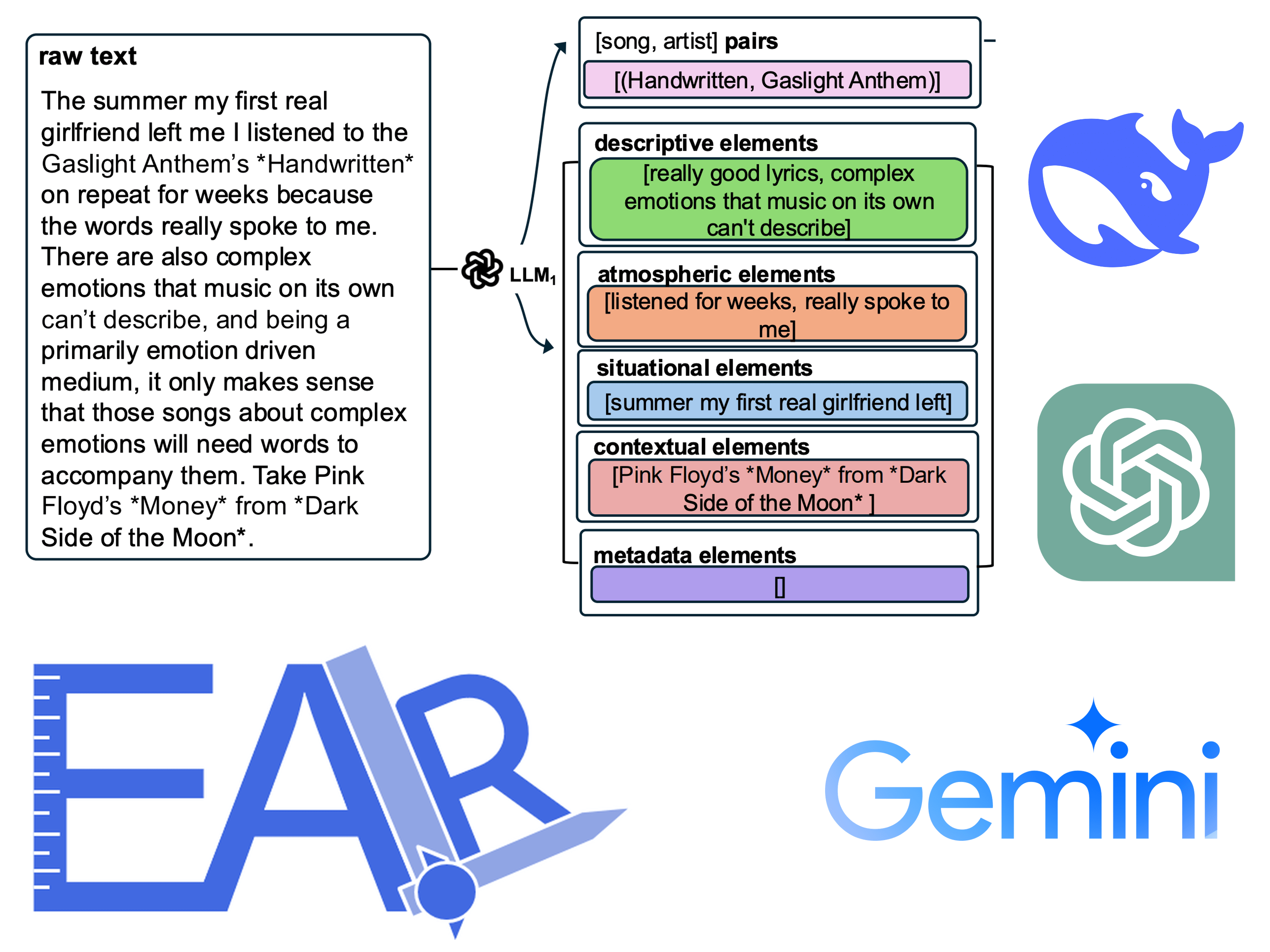
A major focus of my current research is on large language models (LLMs), which are deep learning models trained on vast corpora and capable of performing a wide range of language understanding and generation tasks. These models are reshaping numerous machine learning domains, including graph learning and recommender systems. I have been involved in several projects that benchmark LLMs for multimodal information retrieval, leverage LLM-derived embeddings for improved recommendation, and use LLMs as content annotators and summarizers within recommender systems [23, 31, 32, 33].
The emergence of LLMs also raises critical concerns around fairness, transparency, and accountability. Because these models are trained on massive corpora, they are susceptible to inheriting and reproducing human biases. For example, LLM-based approaches are increasingly being explored in finance, including for credit allocation, where preventing discriminatory outcomes across clients with similar financial profiles is essential. In recommendation, the growing use of these models has also sparked significant debate regarding their societal implications and their ability to promote a fair and diverse cultural landscape. I am leading several projects addressing these challenges, with the broader goal of improving the trustworthiness of LLM-based systems.
To support community debate and critical reflection, I also co-organize the EARL workshop on Evaluating and Applying Recommender Systems with Large Language Models [24]. The last edition, co-located with RecSys 2025 in Prague [34], attracted around one hundred participants and featured 18 papers were presented from industry and academia. A new edition will be co-located with CIKM 2026 in Rome [35].
Agentic Systems
Work in progress.
Real-World Applications
Applications to Music
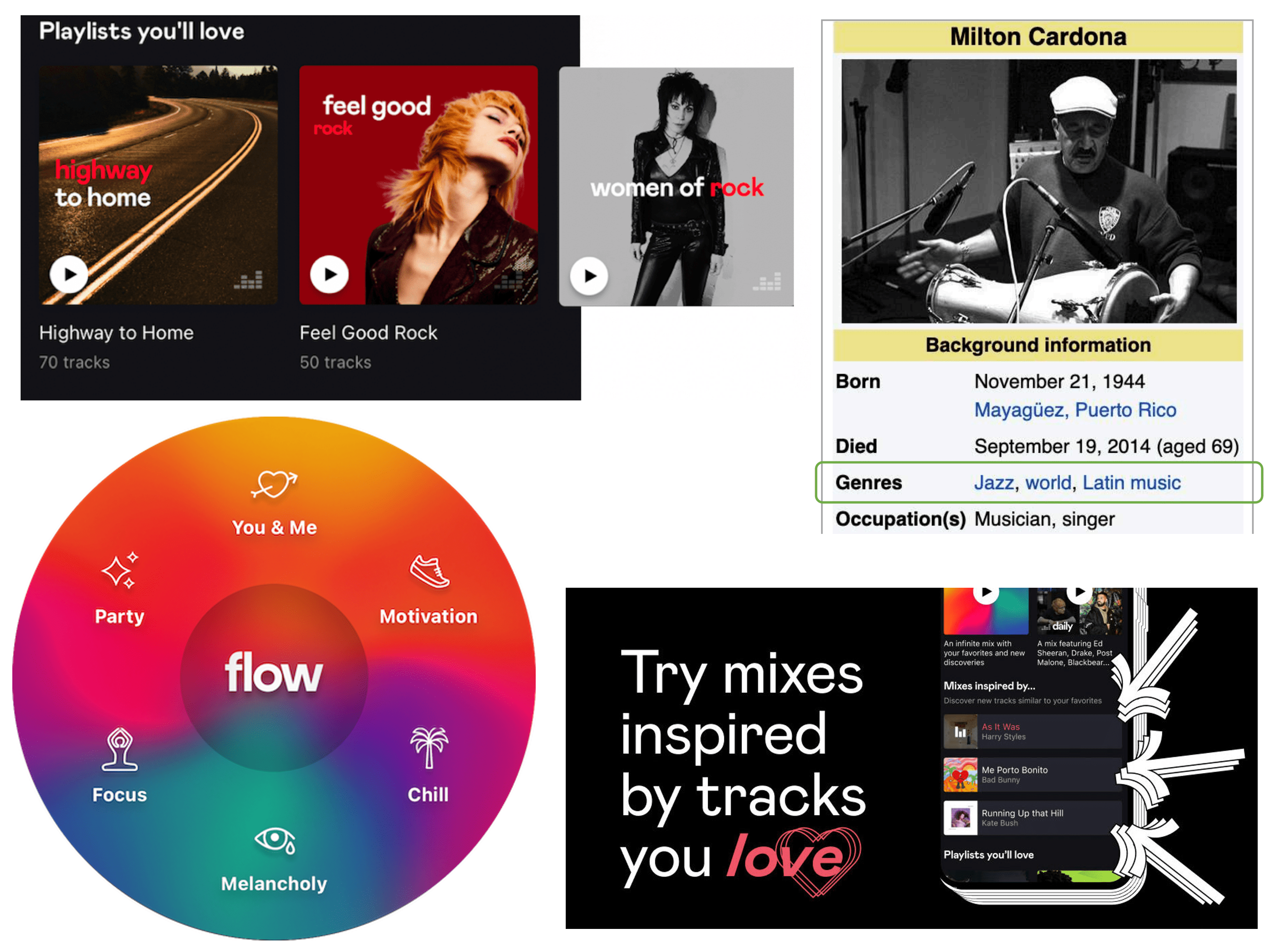
Music has been a natural and central application domain for my research, both due to personal interest and to my seven-year tenure at Deezer, a music streaming service. Many of the graph learning and recommendation projects mentioned earlier were evaluated on music-related data.
More broadly, I co-authored a significant share of the scientific papers describing the music recommender systems we A/B tested and deployed on Deezer between 2018 and 2024. These systems support music discovery for millions of users worldwide. This includes:
- Music carousels: dynamically filling carousels with recommended lists of playlists or albums [13, 18];
- New releases discovery: fostering the discoverability of new releases and emerging artists [13, 25];
- User onboarding: improving music recommendation quality for new users on the service [12];
- Flow moods: recommending music by mood through audio signal analysis and collaborative filtering [26];
- Track mix: generating mix playlists "inspired by" input music tracks, using a GPT model [15, 21];
- Playlist continuation: suggesting music tracks to extend user-generated playlists on the service [16].
I also contributed to exploratory studies, including modeling cultural perceptions of music genres [27, 28, 29] and analyzing the impact of recommender systems on local music promotion [30]. Several of these publications have introduced new datasets, which we publicly released to support reproducibility and scientific research.
I remain actively involved in music-related research, for example through recent collaborations with researchers and engineers from companies such as Deezer (after my departure) [33] and Spotify [37].
Applications Across Domains
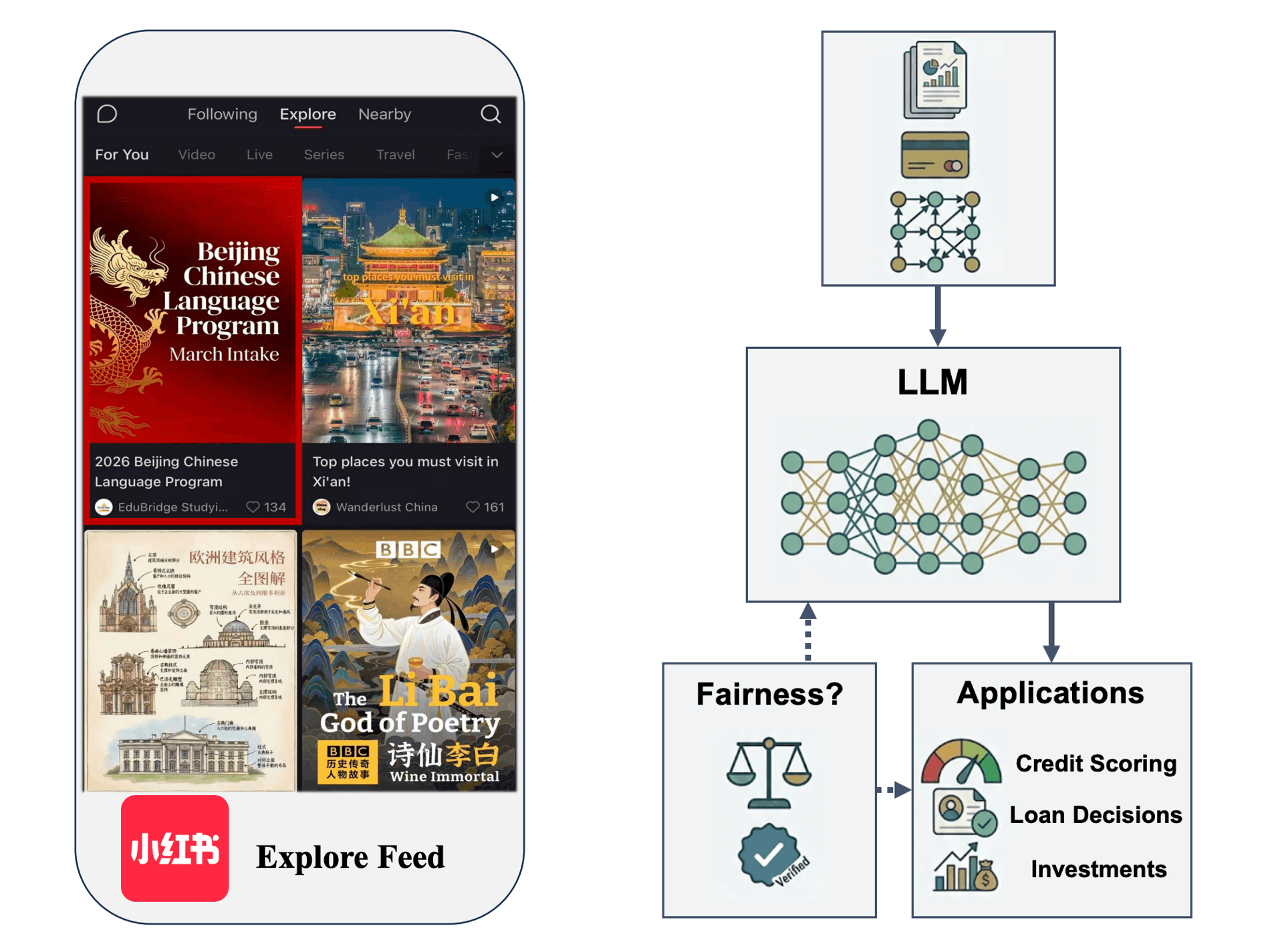
While music has served as a proving ground, the core methodologies I study are highly transferable to many other domains. Since returning to academia at SJTU, I have continued to collaborate closely with industry partners, applying my research to a range of domains beyond music. More broadly, translating my research into industrial applications with real-world impact remains a central objective of my work.
For example, I recently collaborated with Xiaohongshu (RedNote), a leading Chinese content-driven platform integrating social networking, content discovery, and e-commerce. Our recent paper presents the use of multimodal LLMs on this platform to address key challenges related to the exposure of new posts, including videos, images, and user-generated text [32]. The solution has been deployed in both the Content Feed and Display Ads features of Xiaohongshu's Explore Feed, serving hundreds of millions of users daily.
I am also involved in projects addressing biases in LLMs within the financial sector, where these models are increasingly used for investment recommendations, credit scoring, and loan assessments. When such systems exhibit biases, the consequences can be severe. For example, recommending different investment strategies or assigning credit differently to users with identical financial profiles based on sensitive attributes raises ethical concerns. My ongoing research focuses on identifying and mitigating these vulnerabilities to ensure fair and trustworthy AI systems in finance.
Finally, I am exploring applications in other domains, including the use of LLMs in education. More details soon!
Acknowledgments
This research is the result of collaborative work with many talented mentors, colleagues, students, and friends over the years. You will find most of them on my Google Scholar page.